BUY OUR PRODUCTS ONLINE >>
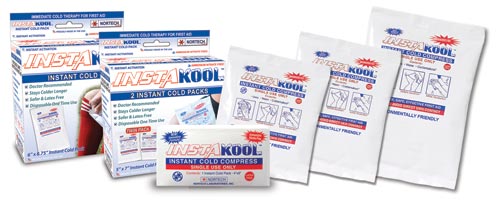
InstaKool™ is an ammonium nitrate free instant cold pack that consists of Water, Urea, and Carbamakool™
- What is Ammonium Nitrate?
A crystal salt that is considered both hazardous and toxic. It’s strong oxidizing agent can cause combustible materials to ignite. Ammonium nitrate when mixed with water can cause irritation to the eyes, nose and skin. Ammonium nitrate under conditions of heat or pressure in a confined space is capable of exploding. - What is Urea?
Urea is a safer alternative for ammonium nitrate. Urea is made up of crystal prills and considered to be safe, non-toxic and Hazmat-Free. This product is non-flammable, non-combustible, and will not burn. Urea, like ammonium nitrate, is used as a fertilizer, feed additive in the agriculture industry. - What is Carbamakool™?
Carbamakool is a proprietary cooling agent to establish colder and longer lasting temperatures as they relate to the initial onset and duration of cold. - Does InstaKool™ Instant Cold Pack Meet American National Standard Minimum Requirements?
Yes. With test information provided, InstaKool™ meets (ANSI) Z308.1-2203. InstaKool™ met temperature requirements at activation and temperature regulations after 15 minutes under normal pressure with no visible leakage. - What testing has been done on InstaKool™ packaging and contents?
Our bags are constructed of low density polyethylene film laminated together so that the orientation of the film of the two plies is at right angles to each other. The minimum thickness of the bag must be not less than 5 mils.
The bags meet the following test requirements:
- Tensile Strength @ Break (ASTM D882)
- Dart Impact Strength (ASTM D1709A)
- Elmendorf Tear (ASTM D1922)
- Ultimate Elongation (ASTM D882)
• Values provided on specification sheet. The values stated refers to the force, given in pounds per square inch, that are required at which the poly mentioned of a specified thickness and sealed to itself will break. - Besides the testing methods, what are the benefits of this particular poly?
• Excellent Adhesion in Sealing.
• Outstanding Cold Stability.
• Low Application Temperature.
• Colorless Product Applications.
• Excellent Resistance and Maintains Flexibility. - What is the cost of shipping a standard instant cold pack that contains HazMat properties such as Ammonium Nitrate?
Average cost per case taking weight into consideration per state is about $5.00/Case. With carriers such as UPS and Federal Express, cost per case is $20.00/Case. Cost per pallet may range from $175 to $250. Learn more about shipping with Ammonium Nitrate. - Is an ORM-D Label Required on a Box or Case of InstaKool™?
No ORM-D Label is required because of InstaKool’s HazMat-Free properties. - Is there any available information on the strength of Nortech’s Corrugated Fibreboard Boxes to make sure the cold packs are well protected?
Nortech’s single wall Corrugated Fibreboard is certified to meet guidelines to help ensure the containment and protection of the product. All packaged products are in accordance with industry performance test method to meet minimum Edge Crush Test (ECT). - What is HazMat?
HazMat is a regulatory term used by the US (DOT) to refer to any substance or material that poses an unreasonable risk to health, safety or property when transported in commerce. HazMat is also known as “Hazardous Material” or “Dangerous Goods” and can include, among other things, manufactured items and commercial products. - At the present time, what is legislation doing about Ammonium Nitrate?
The Ammonium Nitrate Security Act was passed in March of 2005 to regulate use of ammonium nitrate. This initial security act is an introduction in restricting the sale of ammonium nitrate in the future to prevent the potential misuse of ammonium nitrate. The U.S., along with other countries, are taking steps to introduce a licensing and permit system for the use, manufacture, storage, transport, supply, import and export of ammonium nitrate. - What is the future of Ammonium Nitrate?
In the mid 70’s, there were a number of ammonium nitrate makers and suppliers. As of September, 2005, there were two suppliers; one in Canada and the other in the United States. As of October 14th, 2005, a key Canadian supplier moved to eliminate ammonium nitrate completely. There is officially only one supplier left in the United States. - How do I dispose of InstaKool Instant Cold Packs?
InstaKool Cold Packs can be disposed of directly in the trash.
More about Insta-Kool Instant Cold Pack >>
< Back to Articles & Press Releases